Inclusion Isn't an HR Problem. It's an Innovation Problem
The pulse oximeter is one of the most quietly successful medical devices ever made. Clip it to a finger, and it tells you how much oxygen is in someone's blood. Cheap, fast, non-invasive. During the pandemic it was the instrument that decided who got escalated to oxygen and who was sent home.
There was one problem. It works by shining light through the skin and melanin absorbs light. On patients with darker skin, readings drift high, sometimes by several percentage points. In a decision where six to eight percentage points determines whether someone is treated or discharged, that drift is not a rounding error. Research during COVID-19 found Black patients were significantly less likely to receive supplemental oxygen on time, and several times as likely to have low oxygen levels that the device simply failed to detect.

Nobody designed this device to fail Black patients. That's the point.
It failed because the people in the room designing it, the people in the room testing it, and the people in the room signing it off shared a set of assumptions so consistent that nobody thought to question them. The blind spot wasn't malicious. It was structural. And it took roughly fifty years and a global pandemic to correct.
This is what we mean when we say inclusion is an innovation problem, not an HR one.
The business case for diversity is being dismantled — and defending it is the wrong fight
For a decade, the standard argument for diversity in business went like this: diverse companies make more money, here is a consultancy report proving it, therefore do diversity.
That argument is now in serious trouble.
In 2024, accounting academics Jeremiah Green and John Hand attempted to replicate the findings of McKinsey's widely-cited Diversity Matters series. Because the underlying data was never released, they reverse-engineered it — and could not reproduce the results. Using S&P 500 data, they found no statistically significant relationship between executive racial and ethnic diversity and a range of financial performance measures. Their conclusion was blunt: the studies do not support the claim that increasing executive diversity delivers improved financial performance.
Meanwhile, the political weather has turned. Major US corporations have cut DEI roles and quietly retired the language. UK firms have been more cautious than their American counterparts, but plenty are rebranding, "culture", "belonging", "inclusive leadership", hoping to keep the substance while dropping the acronym.
Here is the uncomfortable position many organisations now find themselves in. They built their entire commitment on a financial correlation. The correlation is contested. So the commitment wobbles.
That was always a fragile place to stand. And it was never the strongest argument available.

Diversity is the input. Inclusion is the mechanism.
The most useful research on this doesn't ask whether diverse companies are more profitable. It asks a much more specific question: under what conditions do diverse teams outperform?
Boston Consulting Group surveyed employees at more than 1,700 companies across eight countries and found something striking. Companies with above-average diversity on their management teams reported that 45% of revenue came from innovation, products and services launched in the last three years, compared with 26% at companies with below-average leadership diversity.
But BCG's more important finding is usually left out of the LinkedIn graphic. That effect only appeared where five enabling conditions were present in the working environment. Chief among them: participative leadership. Managers who actually listened to suggestions from their teams and then used them.
Diversity without those conditions did very little.
This maps almost exactly onto Amy Edmondson's decades of work on psychological safety — the shared belief that a team is safe for interpersonal risk-taking. Not niceness. Not permissiveness. The specific confidence that you can say "I think this is wrong" without being embarrassed, dismissed, or quietly sidelined. Harvard Business Review research in 2022 put it plainly: diverse teams need psychological safety to excel. Without it, difference produces friction rather than insight. Teams underperform not because people are different, but because the difference never makes it into the conversation.
So the causal chain isn't diversity → profit. It's:
Diversity gives you access to different perspectives. Inclusion is what converts those perspectives into challenges, questions and ideas. Innovation is what happens when those challenges actually change the decision.
Break the middle link and the whole thing collapses. Which is precisely what happens in most organisations. They hire for difference and then run meetings, governance and sign-off processes that systematically filter it back out.
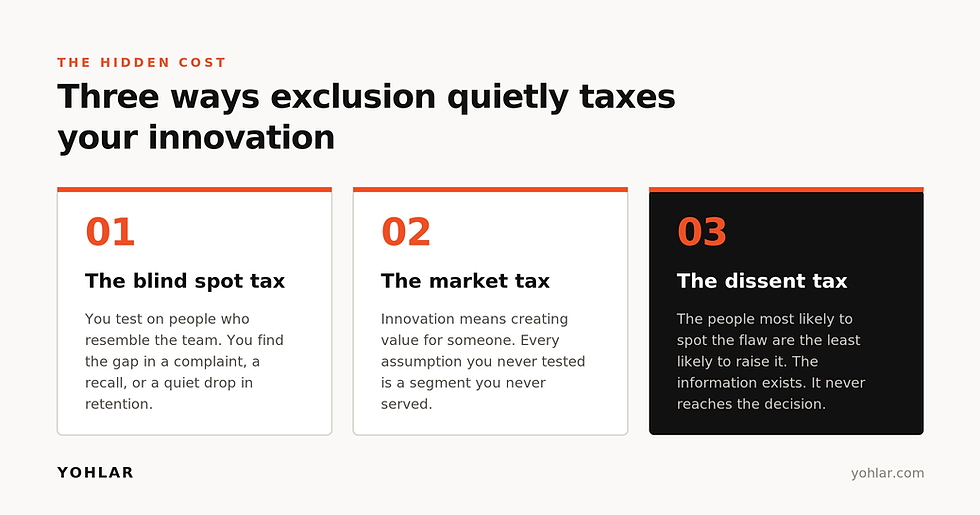
Three ways exclusion quietly taxes your innovation
1. The blind spot tax. The pulse oximeter is the dramatic example, but the everyday version is more common: a product tested on people who resemble the team, a service designed around a customer nobody in the room has ever been, a process that works fine for the people who wrote it. You don't discover these gaps in a workshop. You discover them in a complaint, a recall, or a quiet drop in retention.
2. The market tax. Innovation means creating value for someone. If your understanding of "someone" is narrow, so is your addressable market. Every assumption you never tested is a customer segment you never served — and often a competitor's opening.
3. The dissent tax. This is the expensive one. In organisations without psychological safety, the people most likely to spot the flaw are the people least likely to raise it — junior, newer, or visibly different from the majority. The information exists inside your business. It just never reaches the decision.
The regional reality
For organisations in the North East, this is not abstract. Around 27% of adults in the region report experiencing discrimination at work. The region carries significant health inequalities, low ethnic diversity, and an employment rate where older, disabled, ethnic minority and female workers are most likely to be out of work.
That is a large amount of perspective, lived experience and problem-solving capacity sitting outside the room where solutions get designed. If you are trying to innovate in health, in public services, or in any market that reflects the actual population, that gap is a direct constraint on the quality of what you build.
Treating inclusion as an innovation discipline
If inclusion is an innovation problem, it needs innovation's machinery — not a policy document and an annual training module.
At Yohlar we work through the Power of 3: toolset, skillset, mindset. Our Inclusive Innovation Framework adapts it specifically for this challenge, because each layer addresses a different failure point.
Toolset. Assumption mapping, design thinking and business model innovation methods force teams to write down who they are designing for and what they believe about them. Assumptions that stay unspoken cannot be tested. Assumptions on a wall can be attacked.
Skillset. Facilitating genuine challenge is a learned capability. Most managers have never been taught how to run a session where the quietest person in the room ends up changing the decision. It is a skill, and it is teachable.
Mindset. The hardest and most durable layer. A mindset that treats being wrong as useful information rather than a status threat. Without it, the tools become theatre and the skills go unused.
The output isn't a statement of values. It's a validated action plan — with owners, tests and dates.

What to do this week
Three things, none of which require a budget approval.
Take one live project and list who you are designing for. Then list who you have actually spoken to. The gap between those two lists is your risk register.
Audit your last three significant decisions. Who spoke? Who didn't? Did anyone change their mind, and what changed it? If nobody ever changes their mind in your meetings, you are not making decisions — you are ratifying them.
Ask one person who wasn't consulted what they would have said. Then actually use it, visibly. Nothing builds psychological safety faster than evidence that speaking up works.
Innovation is how you fix things or make them better. You cannot fix what you cannot see. Inclusion is simply the discipline of widening the field of view before you commit resources — and the organisations that treat it that way will keep doing it long after the acronym goes out of fashion.
How inclusive is your organisation, really? Take our one-minute Inclusion by Default assessment and get a full report — or talk to our team about a bespoke Inclusive Innovation workshop for your organisation.