
How to Innovate on a Tight Budget: A Practical Guide for UK Businesses
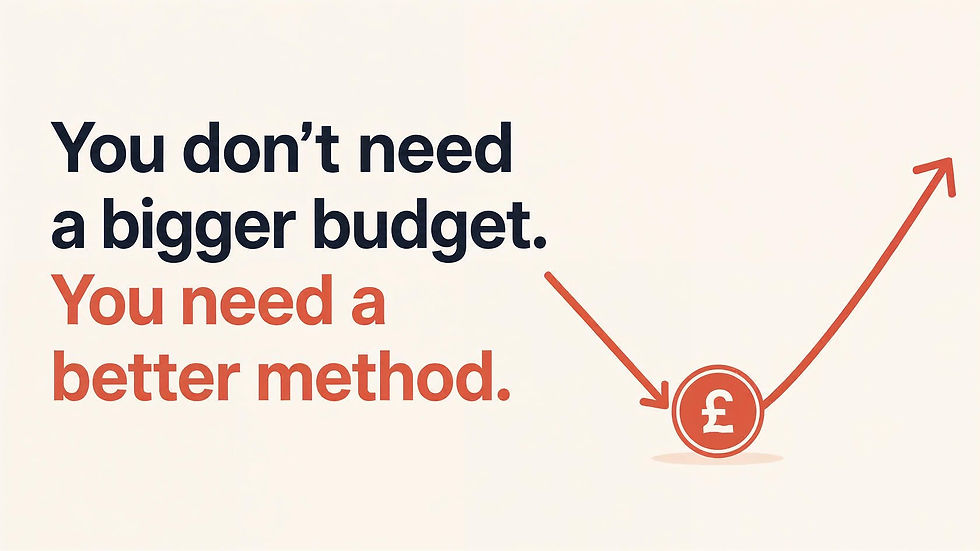
"We'd love to innovate, but we can't afford to."
It's one of the most common things we hear — from small business owners, from charity leaders, from managers inside big organisations whose budget was signed off eighteen months ago and hasn't moved since.
The assumption underneath it is that innovation is expensive. That it needs a lab, a dedicated team, a consultant's day rate and a line item nobody wants to defend at the next board meeting. So it gets postponed to a better year. A year that, funnily enough, never quite arrives.
Here is the more useful truth. The biggest innovations rarely come from the biggest budgets. They come from a clear problem, a tight constraint, and a disciplined way of working through it. In fact, the constraint is often the advantage — and this guide walks through how to use it.
Frugal innovation: doing more with less
There's a name for this. Academics call it frugal innovation — creating more value while using fewer resources: less capital, less time, less kit. It's the discipline of achieving the maximum with the minimum, and it has produced everything from £20 solar lamps to app-only insurers that undercut the incumbents.
The core insight is counter-intuitive but well evidenced. Financial and operational constraints don't just limit innovation — they can drive it. When you can't throw money at a problem, you're forced to understand it properly. You test cheaply, you launch early, you learn fast, and you cut the features nobody actually wanted. A well-funded team can skip all of that and build the wrong thing beautifully.
A tight budget, in other words, imposes exactly the discipline that expensive innovation programmes spend a fortune trying to instil.
The five-step method that costs almost nothing
You don't need a budget to run this. You need a couple of hours, a few of the right people, and the willingness to be wrong early.
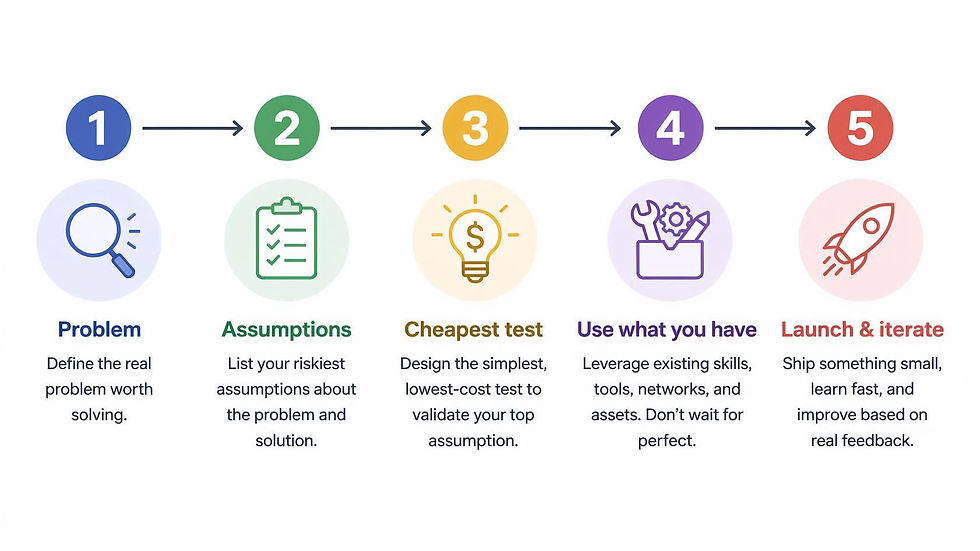
1. Fall in love with the problem, not the solution. Most wasted innovation spend goes on building something before anyone has confirmed the problem is real, painful and widely shared. Before you spend a penny, write the problem down in one sentence. Then ask five people who actually have it whether you've got it right. You will almost always be surprised.
2. Map your assumptions. Every idea is a stack of beliefs — about what customers want, what they'll pay, what's technically possible. List them. Then sort them by two questions: how important is this to the idea working, and how sure are we that it's true? The important-but-unproven assumptions are where your risk lives. Test those first, before anything else.
3. Test the cheapest version that can teach you something. You do not need to build the product to learn whether people want it. A landing page, a mock-up, a sign-up sheet, ten conversations, a single spreadsheet run by hand — each of these can validate or kill an idea for close to nothing. The goal at this stage isn't to build; it's to learn the most for the least.
4. Use what you already have. Frugal innovators lean on open-source tools, existing kit, and partnerships instead of new spend. Who already serves your customers and isn't a competitor? What tool on your existing subscription could be repurposed? The answer is rarely "buy something new."
5. Launch small, then iterate. Put a rough version in front of real users, watch what happens, and improve it. Ten cycles of cheap iteration will beat one expensive big-bang launch almost every time — because each cycle removes a wrong assumption before it becomes an expensive mistake.
None of this requires a grant, a consultant, or a new hire. It requires a method — and the discipline to follow it when your instinct is to skip to building.
The real cost isn't money — it's mindset
Notice what the five steps above actually demand. Not cash. They demand a willingness to test your own ideas, to be wrong in public, and to kill work you're fond of when the evidence says so.
That's the genuine barrier, and it's why the cheapest innovation programmes still fail. The tools are free. The methods are teachable in an afternoon. What's hard is the mindset shift — from defending ideas to interrogating them, from "let's build it and see" to "let's find the cheapest way to learn whether we should build it at all."
This is exactly why our Power of 3 framework treats toolset, skillset and mindset as three separate things. You can hand someone the tools and teach them the skills in a day. Embedding the mindset — the instinct to seek out the cheap test rather than the expensive assumption — is the part that actually changes results. And, conveniently, it's the part that costs nothing but attention.
And when you are ready to spend — UK support that stretches the budget
Frugal innovation gets you a long way for free. But once you've validated something and want to scale it, it's worth knowing the UK support that exists in 2026, because it can multiply a small budget considerably.
R&D tax relief. Since April 2024 the old SME and RDEC schemes have been replaced by a single merged scheme, and the rules that used to penalise grant-funded work were removed — meaning grants and tax relief now stack rather than clash. R&D-intensive small companies (spending at least 30% of total expenditure on qualifying R&D) may qualify for the more generous Enhanced R&D Intensive Support (ERIS) rates.
Innovate UK grants. Innovate UK still funds feasibility studies, industrial research and later-stage projects across sectors from AI and software to net zero and life sciences, with SMART Grants supporting R&D projects up to £500,000. One caution worth flagging: Innovate UK has scaled back its local business-adviser support, so you may need to navigate applications with less hand-holding than before.
None of these are a substitute for doing the cheap validation first. They're an amplifier for an idea you've already proven has legs — which is precisely the right order to do it in.
Start this week, for free
You don't need a better budget year. You need a real problem and two hours.
Pick one challenge in your organisation this week. Write the problem in a single sentence. List the three beliefs it depends on. Then find the cheapest possible way to test the shakiest one — a conversation, a mock-up, a sign-up page. That's innovation. Everything else is just scale.
The organisations that thrive aren't the ones with the deepest pockets. They're the ones that learn the fastest for the least — and that's a discipline anyone can start today.
Want to build that discipline into your team? Our workshops and training turn frugal innovation from a good intention into a repeatable method — using the Power of 3. Explore our training or talk to the team about a session built around your real challenges.


